In-a-Hurry Loan to Cover the Gap

There are several reasons why a fix-n-flip investor might want to secure a fast loan to cover a gap. A gap loan, as the name implies, is a loan that bridges a span of time. It helps you gain control of a property quickly even if you are still scrambling to get all your paperwork done for a full rehabilitation loan.

A Buyer in a Hurry
At some time or other, you might face a seller in a hurry. One situation that puts a seller in a hurry is foreclosure. Many property owners in this situation are in denial so they wait until the last week or so, or even days, before the foreclosure sale to act on saving their credit. To save their credit, they must pay the bank all they owe on the mortgage right now. The house might actually be worth much more than what they owe if they have been paying on the loan a long time or put a large payment down on it. But, a foreclosure on their record will ruin their credit. So, for them, it is better to sell at a discount and survive to buy another house another day.

In this scenario, an owner in foreclosure has agreed to sell the property to you at a steep discount, but they need to close the deal quickly. You, the investor, want to buy this property and you make an offer. However, the competition is extremely stiff, and another investor is sitting in the wings waiting to obtain the property. Your offer locks up control of the property temporarily. You need to move quickly to secure a loan. Normally the loan process takes a minimum of 7 working days and typically takes 10-15 working days.

A Nonrefundable Deposit

Another reason you might need funding in a hurry is that you have stumbled upon a wholesale purchase with a tight deadline to close, perhaps 2 to 5 days. The property is ideal for your purposes and you want to make an offer. However, if you don’t get the deal closed by the deadline, you will lose the nonrefundable deposit you are required to put down and control of the property you are seeking.


mind_the_gap

Getting Control of the Property

Here is where obtaining a gap loan is useful. A gap loan allows you to purchase the property as is while you are in the process of obtaining a rehab loan. The gap loan can be secured in 2 to 3 days typically. Your strategy is to obtain control of the property through this gap loan, begin paperwork to refinance the loan immediately and eventually complete the rehab and offer the property for sale.

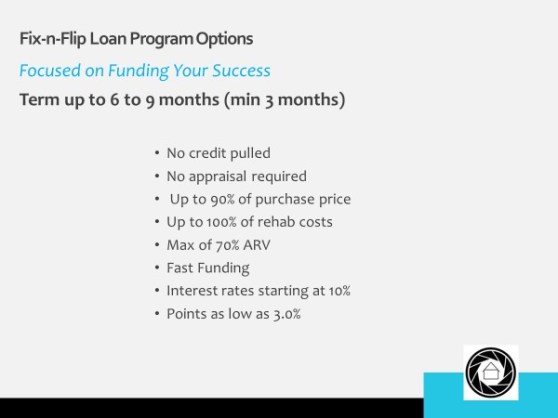
REI Capital Resources has funds available for fix-n-flip loans with terms up to 6 to 9 months with a minimum of 3 months.

Fix-n-Flip Option 2

E-mail or call for more information on minimum and maximum loan amounts, interest rates, terms, and fees for specific project. I can help you with first liens only and these loans are limited to the Austin, DFW, Houston, and San Antonio Metro areas.

Pat St.Cin

Patrick@reicapital.cash

512-213-2271

Austin, Texas

In the Path of a Storm

Alert: Harvey, Irma, Rita, Katrina

Don’t worry, it is not hurricane season yet. However, there are things you need to know now, before the storms approach.

I was just looking at reasons a real-estate investor might lose money on a fix-n-flip project or a vacation rental property deal and stumbled upon natural disasters as a possible cause of investment loss. After reading several articles and searching the real estate websites, I ran into tips for real estate investors facing an approaching natural disaster at yourflipcoach.com, Your Virtual Real Estate Coach. Be sure to visit Ryan’s site if you have a minute.

Insurance Binding
First, as a practical matter, it is very important to know that insurance companies will not bind a new policy or add additional coverage to an existing policy if a hurricane or large storm is headed for Texas. This is important for you to know if you are planning to invest in a property in Texas.

Make sure a hurricane is not on its way. Buy insurance that covers flood and wind damage and replacement costs, and don’t buy the property or the insurance if you can’t bind an insurance policy. Both you and your lender will want insurance on the property. Buy flood and wind insurance on your new property and make sure insurance binders are active well before the next storm.

Closings Disrupted
Second, when you have found a buyer and a storm is approaching, time the closing of the deal so that closing is complete well before the storm event. The storm can get in the way of your closing in so many ways. Following a storm, roads and properties may be damaged and inaccessible. Even if you are dry, routes in and out of your area might be blocked or flooded. You could lose your buyer because they cannot get to you or to the property, or because the property is damaged.

A study performed by the Federal Reserve Bank of Dallas concludes that the “typical hurricane raises real house prices and, to a lesser extent, reduces real incomes for a few years.”

New Business Opportunity 5 Years Out
Third, be ready for new business opportunities following a storm. Damaging natural disasters and the insurance money that comes into the market after they pass can create new opportunities for real estate investors. Some property owners may want to sell, particularly if they did not have insurance. Even if they are insured, many home owners will take their insurance check and sell the property for whatever they can get. Some lots are sold at land value after the home was removed; but once a house is rebuilt, it can be resold again at near the same price in future years (about 5 years).

aerial view atmosphere clouds cold front

Residential Prices Rise Because Housing is Needed
The value of property that is high and dry after a hurricane will increase because homes are lost or uninhabitable. Housing will be needed. And, buyers and investors will be seeking solutions.

An article in Forbes by Jordan Lulich points out that right after a storm, home sales go down because property owners are too busy cleaning up. According to his article, two months after Hurricane Harvey, 31% of residential neighborhoods saw an increase in median house prices here in Texas.

It is still smart to invest in real estate in hurricane prone areas because residential property values increase over time. Repair costs associated with storms are certainly worrisome. Just be sure to buy insurance that covers wind and water damage to protect your asset.

Please give me a call when you find that perfect investment, and I can help you fund the project.

Patrick St.Cin
512-213-2271
Patrick@REICapital.cash


References
Ryan Kuhlman, January 8, 2018, Natural Disasters and Real Estate Investing, https://yourflipcoach.com/natural-disasters-and-real-estate-investing/

Jordan Lulich, June 28, 2018, Does Hurricane Damage Negatively Impact Your Real Estate Value/
Forbes https://www.forbes.com/sites/jordanlulich/2018/06/25/does-hurricane-damage-negatively-impact-your-real-estate-value/#381ca6d5107b

Murphy, Anthony and Stroble, Eric, October 2010, The Impact of Hurricanes on Housing Prices: Evidence from US Coastal Cities. Federal Reserve Bank of Dallas, Research Department, Working Paper 1009, https://www.dallasfed.org/


How to Use a Hard Money Loan to Get Your Real Estate Property Ready to Sell

How Much Money Do You Need?

There are some basic things you need to know before you can get a hard money loan. First, you need to know how much you need to borrow and how much collateral you have. You begin by finding out how much your real property (house or apartment complex) is worth as is.1 Note the words “as is.” You can get this information from a real estate appraiser. Then you ask them to make a second estimate about how much more the property will be worth if obvious repairs are made.

IMG_00003652Next, get a remodeling contractor to give you a bid on the repairs and a plan or time frame the repairs will take. You might want to get several bids and choose the one that looks best to you.

How Much Collateral Do You Have?

Second, find out how much you owe on the property. The difference between the amount you owe and the appraised value of the property is your equity. It is the equity that will determine how much the lender will lend you.2 Compare the amount of the cost of the repairs to your equity after the repair is make. If your equity is larger than the repairs, you might be able to make a profit after paying off the loan.

IMG_00003655

The amount of money you need to borrow is the amount the repairs will cost plus a cushion of maybe 15 percent. The amount of collateral you can offer the lender is the equity in the real property. If the equity value of the real property is larger than the amount it will take to fix the property up, you have collateral to get a hard money loan.

Who Are the Lenders?

Hard money loans are typically issued by private investors (individuals or groups) lending their own money to borrowers with real property. The real property is their protection for making the loan and will be taken if the loan is not repaid. The primary basis for making a hard money loan is the liquidation value of the collateral backing the note.3  While the bank on the street corner will check basically everything before issuing a loan, including your credit scores, your income, the stability of your income, any missed payments, the amount of outstanding credit you have, and how the internal revenue service feels about you, the hard money lender will be are more interested in the value of your collateral than in your credit history. The hard money lender will determine the value of the property by getting an independent appraisal.

How Much Will It Cost Me?

Interest rates on a hard money loan will start at about 7.7 percent.1 The rate will depend on several things, including the liquidity of the asset. If the house you are repairing is in a bad neighborhood, it might be hard to sell even after it is remodeled and thus the interest rate on the loan will be higher. Broker fees also apply if a broker helped you find the funding source.

IMG_00003705_edit

The broker offers personal service to the borrower and administrative service to the lender. They give advice, do the paperwork, and make the phone calls involved in the transaction. They will also have the day-to-day experience and contacts to find the best rates for you. They then pass on the completed application to the lender.

Summary

In summary, if you are in a bad credit situation, have equity in real property you own, anticipate a project that will not take too long, and need money quickly, the hard money loan is probably for you.

If you find a deal, give me a call for a quick closing fix-n-flip rehabilitation loan. You can e-mail too.

Patrick@InvestorsLendingSource.com

Austin, Texas

512-213-2271

References

1. Hard Money Loans: A Complete Guide. California Hard Money Direct. Available at https://californiahardmoneydirect.net/2017/04/21/hard-money-loans-guide/. Retrieved November 2018.

2. Justine Pritchard, Hard Money Basics, How Hard Money Loans Work. Available online at https://www.thebalance.com/hard-money-basics-315413. Updated October 31, 2018. Accessed November 2018.

3. Wikipedia. Hard Money Loan. Available online at https://en.wikipedia.org/wiki/Hard_money_loan/. Accessed November 16, 2018.


4 Most Common Mistakes that Slow Down the Loan Process

Getting a property financed can be an overwhelming process. Sometimes borrowers don’t recognize the bumps in the road that will derail their project plans and loan schedule. Here is a list to help you see and remember the small, but important, details involved in getting a loan. These are the most common time sucking land mines that drag the loan process out (or even cause disqualification) along with tips to avoid them.

  1. Scheduling & Anticipating the Appraisal

Loans officially start when they are put into processing, which does not happen until appraisal reports are turned in or the application fee is paid. A loan will be delayed if there is an issue getting the appraisal. Sometimes a borrower will schedule an appraisal when the property is not available or repairs/rehab are incomplete. For example, someone may live in or on the property and will not allow the appraiser access to the property. The loan will be delayed if this happens. If the appraiser arrives and finds the home in the midst of rehab, the loan will also be delayed.

Another bump in the road related to the appraisal occurs when the value of the property is based on too little research. This usually leads to an inflated initial value. If the appraisal comes in lower than what the borrower expected, this will delay the loan process and can even halt it altogether.

Key: Be ready, careful, and deliberate about scheduling the appraisal. Coordinate with the current occupants and your contractor.

Key: Be really accurate from the start about the value of the property.

  1. Documentation

Procrastination, my favorite strategy, does not help when it comes to loan documentation; like taxes and even more than hearing protection, documentation is required. It is a terrible idea to wait to start gathering the documents necessary to move the loan process along until the appraisal comes in. Start by making a list of the documents you need as soon as you come up with your project and begin immediately, while the idea is hot, to gather them and check them off your list. Your goal is to have them ready as soon as your loan goes into processing.

Key: Gather the necessary documents when your idea is hot.

FileStack_retouched

  1. Hazard: Wrong Policy Type or Amount

You might not think of hazard insurance in connection with your loan but obtaining hazard insurance is a very important component to securing a loan. Carefully study the types of coverage available and don’t just buy a policy to say you have it. Buy hazard insurance that covers 100% of the replacement cost of the property and calculate the premium carefully. Often the wrong type or amount of coverage is purchased, which will not only slow the loan down but can also potentially change your loan parameters (up to and including disqualification).

Key: Know your numbers. Buy hazard insurance that covers 100% of the replacement cost of your property

  1. Title Clouds

Liens, judgments, delinquent taxes, and mortgage releases are all common things that show up on a title. These things take time to clean up and drag the loan process out. Be sure to check your title for these attachments before you start your loan. If you have any clouds on the title, you’ll want to clean them up asap to keep your loan on schedule.

Key: Start early, Clean up the title ASAP.

Patience may be a virtue, but it is one that is often tested when you are eager to close a loan and get on with your project. To save your dream and your nerves, follow these tips: coordinate the appraisal, be accurate on the value, gather the necessary documents, buy the right insurance, and clean up that title.

I would be pleased to give you a hand, and I have funds available for lending.

Patrick@InvestorsLendingSource.com

512-213-2271

Austin, Texas


Photo credit: Niklas Bildhauer CC BY-SA 2.0 (https://creativecommons.org/licenses/by-sa/2.0)

How to Close Your Visio Loan Fast

Attention. Today, it is hard to focus the laser beam of our mind onto what is pivotal. Our mind certainly can be a laser beam, but too often it flickers, back and forth from one thing to another like a match in a wind storm. If time is money, attention is gold, and a sense of urgency can be your friend when you are interested in borrowing money to start your rental or vacation rental business.

My goal here is to help you sort out what Visio needs to know, what is pivotal in the process of financing an investment property, one that you want to buy and hold onto as an investment. By focusing on these critical areas, you can speed up and simplify the process of getting your loan Visio loan closed.

Pivot 1. Property Value beyond the Appraisal

Talk to your local realtor and do your own research to determine the comparable value of your property. Appraisals provide us with helpful indications of value, but we also rely heavily on our own research and analysis. Please let us know if you’ve made improvements to the home, detailing what has been done and the amounts invested.

Please let us know if you’ve made improvements to the home.

Pivot 2. Property Condition

Appraisers rate property condition using a scale of C1 (New) to C6 (Complete Redevelopment). We only lend on rent-ready properties (C1–C4). ALL repairs and rehab should be completed PRIOR to starting a loan with Visio. While we sometimes finance properties requiring some minor redevelopment, we make these decisions on a case-by-case basis. If you are concerned that your property may need too much work to qualify, send us some current pictures before ordering the appraisal.

We only lend on rent-ready properties (C1–C4).


eaton_house-e1550775911323.jpg

Pivot 3. Recent Transactions

If the home has changed hands in rapid succession with significant increases in value, we need to know ahead of time. We need to understand the reasons behind the increase in value before making the loan. Finding out late in the transaction almost always causes problems.

We need to understand the reasons behind the increase in value before making the loan.

Pivot 4. Non-Arm-Length Transactions

A non-arms-length transaction involves a buyer and seller that have a pre-existing business, personal, or familial relationship. We will make these loans, but we want to know up front. Visio is not a consumer mortgage lender, and therefore cannot allow family of the borrower to remain in the property.

Visio is not a consumer mortgage lender, and therefore cannot allow family of the borrower to remain in the property.

Pivot 5. Fees

Our Account Executives will provide you with a detailed fee worksheet showing all our fees well in advance of closing. Please read the fee worksheet. It is not in anyone’s interests to have a deal fall apart at the closing table over fees.

Please read the fee worksheet.

Pivot 6. Title

If you are refinancing with Visio please give careful thought to any liens, judgments, or delinquent property taxes on the property. These will come up during the title phase, and they not only take time to clean-up but could also result in disqualification. If you’re buying a property, we require a clean title to close. Items such as releases of old mortgages or the existence of ground rents/land leases, which are common in some areas (MD), can take substantial time and effort to address.

We require a clean title to close.

Pivot 7. Borrower Name(s)

If you are refinancing with Visio, please consider whether there is anyone else on the title with you. That person will need to be available to sign documents. In addition, we will title the property the way it comes to us. If you are attempting to remove anyone from or add anyone to title, please resolve this prior to starting a loan with Visio (see “Borrowing in an Entity” below for exceptions). For purchases, if you are buying from a government agency, such as HUD, execute the purchase contract in the exact name in which you intend to hold the title. They are not very flexible about changing names mid-transaction.

Execute the purchase contract in the exact name in which you intend to hold the title.

Pivot 8. Investor Insurance

Research and choose your insurance product EARLY. It likely will take longer than you think. Consider the cost as well. If your premium is proven to be more expensive than you are estimating, it could potentially change your loan parameters, up to, and including disqualification. Accurate escrow estimation is paramount to an accurate quote from Visio. Please note, we require hazard insurance to have 100% replacement cost. We do not allow actual cash value policies.

We require hazard insurance to have 100% replacement cost.

Pivot 9. Borrowing in an Entity

We lend to entities, such as corporations, LLCs, and partnerships. Please make sure your entity is fully established and is in good standing. We’ll need all the documents to complete your loan. If you are attempting to change the titled entity, we can accommodate if the ownership interest is identical between both entities. (See “Borrower Name” above.) We do NOT lend to trusts nor non-profit corporations.

We do NOT lend to trusts nor non-profit corporations.  

Pivot 10. Sense of Urgency

Time and attention is always of the essence. Thoroughly read emails and respond to communication from your account executive and processor. We are always available to help and provide clarification to ensure a smooth transaction.

Thoroughly read emails and respond.

Give me a call or send an e-mail and I will help you to move quickly, get the best deal, and start making money sooner.

Patrick@InvestorsLendingSource.com

512-213-2271

Austin, Texas


Photo reference: Lmatt123 [CC BY 3.0 (https://creativecommons.org/licenses/by/3.0)%5D

 

In-a-Hurry Loan to Cover the Gap

There are several reasons why a fix-n-flip investor might want to secure a fast loan to cover a gap. A gap loan, as the name implies, is a loan that bridges a span of time. It helps you gain control of a property quickly even if you are still scrambling to get all your paperwork done for a full rehabilitation loan.

A Buyer in a Hurry
At some time or other, you might face a seller in a hurry. One situation that puts a seller in a hurry is foreclosure. Many property owners in this situation are in denial so they wait until the last week or so, or even days, before the foreclosure sale to act on saving their credit. To save their credit, they must pay the bank all they owe on the mortgage right now. The house might actually be worth much more than what they owe if they have been paying on the loan a long time or put a large payment down on it. But, a foreclosure on their record will ruin their credit. So, for them, it is better to sell at a discount and survive to buy another house another day.

In this scenario, an owner in foreclosure has agreed to sell the property to you at a steep discount, but they need to close the deal quickly. You, the investor, want to buy this property and you make an offer. However, the competition is extremely stiff, and another investor is sitting in the wings waiting to obtain the property. Your offer locks up control of the property temporarily. You need to move quickly to secure a loan. Normally the loan process takes a minimum of 7 working days and typically takes 10-15 working days.

A Nonrefundable Deposit

Another reason you might need funding in a hurry is that you have stumbled upon a wholesale purchase with a tight deadline to close, perhaps 2 to 5 days. The property is ideal for your purposes and you want to make an offer. However, if you don’t get the deal closed by the deadline, you will lose the nonrefundable deposit you are required to put down and control of the property you are seeking.


mind_the_gap

Getting Control of the Property

Here is where obtaining a gap loan is useful. A gap loan allows you to purchase the property as is while you are in the process of obtaining a rehab loan. The gap loan can be secured in 2 to 3 days typically. Your strategy is to obtain control of the property through this gap loan, begin paperwork to refinance the loan immediately and eventually complete the rehab and offer the property for sale.

REI Capital Resources has funds available for fix-n-flip loans with terms up to 6 to 9 months with a minimum of 3 months.

Fix-n-Flip Option 2

E-mail or call for more information on minimum and maximum loan amounts, interest rates, terms, and fees for specific project. I can help you with first liens only and these loans are limited to the Austin, DFW, Houston, and San Antonio Metro areas.

Pat St.Cin

Patrick@reicapital.cash

512-213-2271

Austin, Texas

No Hammer Renting

I was reading an article by Ryan Dezember in the wsj about house renting companies that are starting to see a benefit in buying suburban houses to rent rather than remodeling older homes in the city. The article summarized some interesting points and strategies that are worth considering.

The rationale for buying a new house to rent out arises out of evolving situations that home buyers are facing. When housing prices go up in the suburbs, young families cannot find homes at entry-level prices that they can afford. Many of them are burdened with student debt and don’t have the credit standing to buy the higher priced new homes. So, they are willing to rent to make sure their kids get to go to good schools and live in safe neighborhoods.

Steady Income

Renting houses (old ones or new ones) is a promising investment for those who want a steady income instead of a big single payoff. New single-family homes, versus older ones, can be expected to attractive to renters, stay occupied, and provide steady income.

There seems to be two ways to make this investment work: 1. Buy a new house and rent it out yourself, or (2) buy a new house, find occupants for it, and then sell them to a big housing rental company. According to the wsj article, there are quite a few rental home companies starting to look at buying rental houses in the suburbs.

Buying new has benefits:

  • Save on sales commissions,
  • Save on remodeling costs,
  • Charge more rent for a new home,
  • Outfit the house with the preferred fixtures to rent them faster, and
  • Save on maintenance costs for 10 years or so

Since this idea is starting to get around, getting the money quickly so you can squeeze out the competition is something that I can help you with. For rental properties, I offer loans at low interest rates, for terms of 3 to 7 years, with low closing costs, quick closings (15-20) days, and a loan that is based on the asset rather than on your personal credit record so there is less personal paperwork to do.

So, talk to a builder near you who is willing to sell cheap to clear the books at the end of the fiscal year and find occupants, and prepare for a steady income for years to come.

For a quick pre qualification application, follow this link: http://investorslendingsource.com/pre-qualification-program

I would be pleased to have you call or e-mail too.

confused-muddled-illogical-disoriented.jpg

Pat St. Cin

Patrick@InvestorsLendingSource.com

512-213-2271

Austin, Texas

Photo by Pixabay on Pexels.com


$105,000 Fix-n-Flip SFR in Houston Closed

Happy Monday. A Loan Closing  — Investors and builders coming together to finish a project and potentially profit. This is what makes ILS tick.  I am taking this time to share this excellent news in the final month of 2018.

Patrick@InvestorsLendingSource.com, 512-213-2271

Recently Closed Private Loan
$105,000 Loan Closed
Single Lender First Note
Fix-n-Flip SFR
Houston

time lapse photography of fireworks display

Photo by ViTalko on Pexels.com

How to Use a Hard Money Loan to Get Your Real Estate Property Ready to Sell

How Much Money Do You Need?

There are some basic things you need to know before you can get a hard money loan. First, you need to know how much you need to borrow and how much collateral you have. You begin by finding out how much your real property (house or apartment complex) is worth as is.1 Note the words “as is.” You can get this information from a real estate appraiser. Then you ask them to make a second estimate about how much more the property will be worth if obvious repairs are made.

IMG_00003652Next, get a remodeling contractor to give you a bid on the repairs and a plan or time frame the repairs will take. You might want to get several bids and choose the one that looks best to you.


How Much Collateral Do You Have?

Second, find out how much you owe on the property. The difference between the amount you owe and the appraised value of the property is your equity. It is the equity that will determine how much the lender will lend you.2 Compare the amount of the cost of the repairs to your equity after the repair is make. If your equity is larger than the repairs, you might be able to make a profit after paying off the loan.

IMG_00003655

The amount of money you need to borrow is the amount the repairs will cost plus a cushion of maybe 15 percent. The amount of collateral you can offer the lender is the equity in the real property. If the equity value of the real property is larger than the amount it will take to fix the property up, you have collateral to get a hard money loan.

Who Are the Lenders?

Hard money loans are typically issued by private investors (individuals or groups) lending their own money to borrowers with real property. The real property is their protection for making the loan and will be taken if the loan is not repaid. The primary basis for making a hard money loan is the liquidation value of the collateral backing the note.3  While the bank on the street corner will check basically everything before issuing a loan, including your credit scores, your income, the stability of your income, any missed payments, the amount of outstanding credit you have, and how the internal revenue service feels about you, the hard money lender will be are more interested in the value of your collateral than in your credit history. The hard money lender will determine the value of the property by getting an independent appraisal.

How Much Will It Cost Me?

Interest rates on a hard money loan will start at about 7.7 percent.1 The rate will depend on several things, including the liquidity of the asset. If the house you are repairing is in a bad neighborhood, it might be hard to sell even after it is remodeled and thus the interest rate on the loan will be higher. Broker fees also apply if a broker helped you find the funding source.

IMG_00003705_edit

The broker offers personal service to the borrower and administrative service to the lender. They give advice, do the paperwork, and make the phone calls involved in the transaction. They will also have the day-to-day experience and contacts to find the best rates for you. They then pass on the completed application to the lender.

Summary

In summary, if you are in a bad credit situation, have equity in real property you own, anticipate a project that will not take too long, and need money quickly, the hard money loan is probably for you.

If you find a deal, give me a call for a quick closing fix-n-flip rehabilitation loan. You can e-mail too.

Patrick@InvestorsLendingSource.com

Austin, Texas

512-213-2271

References

1. Hard Money Loans: A Complete Guide. California Hard Money Direct. Available at https://californiahardmoneydirect.net/2017/04/21/hard-money-loans-guide/. Retrieved November 2018.

2. Justine Pritchard, Hard Money Basics, How Hard Money Loans Work. Available online at https://www.thebalance.com/hard-money-basics-315413. Updated October 31, 2018. Accessed November 2018.

3. Wikipedia. Hard Money Loan. Available online at https://en.wikipedia.org/wiki/Hard_money_loan/. Accessed November 16, 2018.