Jobs = Confidence

U.S. Stocks Rallied again yesterday as corporate earnings and a good jobs report strengthened our confidence in investing. According to Investopedia, “The Market Sum,” by Caleb Silver, “We are six weeks deep into a stock market rally, the likes of which we haven’t seen since 1987.”

U.S. employers added an average of 223,000 jobs per month in 2018, much higher than the 170,000 per month predicted. 248,000 of those jobs were in the manufacturing sector, putting a dent in the 1.2 million manufacturing jobs wiped out in the last recession (Investopedia.com).

U.S. Occupations

If you want to know what type of jobs are in the U.S. labor market, you need to look at both the occupation (worker) and the industry (employer). You can use occupational employment statistics (OES) (published by the US Department of Labor at https://www.bls.gov/oes/) to compare occupations. You can see employment levels and wages for occupations where you live or in the type of business where you work.

According to the OES for the nation, retail sales person is the largest occupation. Next is food preparation and serving persons; then cashiers, office clerks, registered nurses, customer service representatives, laborers and freight movers, waitresses and waiters, secretaries, and general operations managers. These are the top ten occupations in the country. Manufacturing is not there — yet.

Loan Officer in Texas

You can look up “Loan Officer” though, and there are 307,240 loan officers making a mean hourly wage of $37.00 an hour, and interestingly enough, Texas has the second highest number of working loan officers (20, 810), second to California (39,520), with a mean annual income of $86,460.

Strangely, the top paying metropolitan area in the country for this occupation is Laredo, Texas, with a mean annual salary of $131,200. They don’t say how many loan officers there are in Laredo making this salary though. Lubbock, Texas is in seventh place on the top ten, with 260 loan officers, making a mean annual salary of $117,500 each. Number eight is Victoria, Texas, with 70 loan officers making a mean annual salary of $114,230 each.

So What? I think this means that Texas has a lot of money to lend.

Real Estate Brokers

What do the statistics say about “Real Estate Brokers?” First, there are 36,410 real estate brokers working in real estate in the U.S., with others working in management, building construction, credit, and business and professional organizations. Texas is fifth, with 2,290 workers employed in this occupation, compared to California with 5,570. In Texas, Dallas-Plano-Irving is the Texas metropolitan area on the list of areas with the highest employment level in real estate brokering, 830 brokers with a mean annual salary of $80,410.

Cowboys

Sad as it may sound, the song is right. “Mothers, don’t let your sons grow up to be cowboys.” I could find hunters and trappers on the list of occupations, but no cowboys. That cannot be right. This is Texas!

An occupation gives us purpose and confidence. Work is good.

I am a real estate broker. I work with people, land, homes, and money. I, myself, only see the back end of a cow when I visit Kansas. What could get better than that.

cowboy_hats.jpg

If you or your partner have a real estate purchase you would like to make or money you would like to invest in a real estate project, don’t forget, I’m on the net, in the book, and this is what I love to do.

Pat St. Cin

Patrick@InvestorsLendingSource.com

512-213-2271

Austin, Texas


References:

The Market Sum, by Caleb Silver at Investopedia.com

US Department of Labor at https://www.bls.gov/oes/

Cowboy hats. Nika Vee, Austin [CC BY 2.0 (https://creativecommons.org/licenses/by/2.0)%5D, via Wikimedia Commons



$142,000 Fractionalized 1st Lien Closed — Investor’s Lending Source

Happy First of February! A Loan Closing in Killeen, TX —This is what makes ILS tick. I am taking this time to share this excellent news in these first days of February, 2019. Recently Closed Loan with Private Funds ARV $142,000 LTC 95.8% LTV 57.9% Private Funds – Fractionalized 1st Lien Exit Strategy: Fix to […]

via $142,000 Fractionalized 1st Lien Closed — Investor’s Lending Source

It’s Real: Multi-Family Property Investing

As the stock market quivers and stock market investors peer into the fog of the future trying to see where stocks, the economy, and earnings are going, up, down, or sidewise, real estate stands firm, on a block, in a neighborhood, around the corner from this or that, providing shelter to human beings. It might be old or new, trendy or dilapidated, occupied or abandoned, but it is real and panics are not going to move it, even if fire, earthquake, wind, or water might. Housing is still a basic need and if an investment fills a basic need, it is a safer investment.

An investment is not safe though if you do not do your research and match the facts of the property and area situation with your needs, expectations, and goals. When considering investing in multi-family properties, be sure to pay close attention to the quality of property management and to the location. This might be a good time to refresh your memory on investor shorthand for communicating with each other on property types. It really kind of easy, like: A, B, C, and D.

The letter grades are assigned based on property characteristics like, age, tenant income level, growth areas, appreciation, amenities, and rental rates according to ApartmentVestors.com. The grade isn’t there to scare you away from a certain property because it receives a low grade. (Although D areas in dangerous neighborhoods are not investments to be taken lightly or by beginners.) The property grade is there to help you set realistic goals for your investment and to communicate within the industry about what you are looking for.

Multi – Family Property Class A. Class A properties are newer, built in the last 15 years and have the most amenities, lowest vacancies, demand highest rents, and have less maintenance costs. These properties are above average in terms of design, construction, and finish; the tenants make above-average incomes, they are in desirable locations and they are accessible. These apartments are professionally managed by national or large regional management companies.

Investment sense: These buildings have the most appreciation potential but less cash flow starting out. Professionally managed and in desirable areas.

Multi – Family Property Class B

Class B properties were built in the last 15 to 30 years and have some amenities. The rents are average, a bit lower than Class A buildings. Tenants are usually a mix of corporate workers and skilled trades people. These apartments are in desirable places but do not have the design and finish reflective of the latest standards and preferences. The construction is adequate, and the buildings are generally well maintained by national or regional management companies; unit sizes are usually larger than current standards. These buildings have some appreciation potential and decent cash flow rates.

Investment sense: These buildings have the good appreciation potential and more cash flow than Class A. Professionally managed and in desirable areas.

Multi – Family Property Class C

Class C properties are older, built more than 30 years ago. They have fewer amenities, if any. The tenants are mostly service employees and you might have some government-subsidized tenants. Rents are below average, lower than Class B rents, and the occupancy rate is lower. These apartments provide functional housing, exhibit some level of deferred maintenance, are usually located in less desirable areas, and are generally managed by smaller, local property management companies and private investment groups. Cash flow is high, but appreciation is much lower than Class A or B apartments.

Investment sense: These buildings have the little appreciation potential, but cash flow is high. Property management varies because it is local and performed by smaller companies. It might be great, quirky, or terrible. Be sure to check. The location is less desirable but still safe.

Multi – Family Property Class D

Class D apartments are in challenging neighborhoods and potentially dangerous areas. They are older buildings, with no amenities, and high deferred maintenance. The tenants can be challenging, and management is intensive. Cash flow is reduced by lack of payment by tenants and repairs.

Investment sense: These buildings have no appreciation potential and cash flow is reduced. Property management varies because it is local and performed by smaller companies or it might not be performed at all. Be sure to look around carefully. The location could be dangerous, and it might be hard to attract tenants to the area.

Property and Area

When you are looking at buildings and the areas they are built in, apartmentvestors.com recommends that you pick a property in an area that has a higher class rating than the property. The area classes, like the property classes are A, B, C, and D. With A being a growth area, B being an older stable area, C being an older declining area, and D being older and declining, potentially rapidly declining area.

Apartmentvestors.com offers a strategy that suggests it is better to pick a D house in an A area because the area will have more influence over the stability of your investment over time. I would call this the domain of the fix-n-flip investor. As the deep urban areas or warehouse districts become more appealing to working professionals, a building that was once a C property in a D area might become a D property in an A area and be well worth renovating. But you need to be sure the area classification is really changing.

If you are a hands-off straightforward investor, not a fix-n-flipper, you might want to look only at the A and B properties in the A and B areas if you are taking a long-term approach and interested in appreciation in value. However, you might be more interested in cash flow. Then you might want to look at B and C properties in B, or C areas.

That is a lot of alphabet flying around.

If you have a multi-family property in mind and are ready to start negotiating or are ready to buy, send me an e-mail or give me a call and I can help the funding.

Pat St. Cin

Patrick@InvestorsLendingSource.com

512-213-2271

Austin, Texas


References: apartmentvestors.com

Decorating a Rental

Clean & Presentable

Rob B. and Rob D., founders of the investor forum and advice website, The Property Hub, share decorating choices that every landlord needs to know on housebeautiful.com.

Although the larger housebeautiful.com website tells us that matte black is the latest color choice for home decorating, Rob B. and Rob D. recommend that decorating a rental property should not be about personal expression but about appealing to “everyone and anyone,” durability, and cost effectiveness.

No Dog Shower

A rental is not a flip. Keep it simple is the rule. There is no need to go overboard buying the latest luxury fixtures or fittings. You also don’t need to gut the kitchen if it is functional. That means the dog shower in the laundry room that they are talking about over on the sweetwaterliving.com blog is not on your shopping list for the rental property even if you want to put one in your own mudroom. In case you are wondering where that came from

, a dog shower is one of the other latest interior design trends we can expect to see in 2019. However, your goal for the rental is to make the property clean and presentable. You might not even allow dogs.

No White Carpet

Decorating a rental is very straight forward. For the floor, opt for laminate in the kitchens, bathrooms, and hallways because it is easy to clean and if you get decent quality laminate, it should not rip or tear. Laminate is easier to clean than carpet and it will not look dirty or worn as quickly as a light-colored carpet would. Rob and Rob advise that if you must put down carpet, put down dark colors with a good underlay.

For the walls, choose white and light grey throughout and opt for water resistant eggshell or acrylic paint in the kitchen and bathroom. If you own many rentals, use the same color in all of them so you have some around for touchups.

For the bathroom, install a shower over a bathtub rather than a shower over a shower tray and try to put in at least a second toilet, if not a second complete bathroom, so if something breaks it is not such an emergency.

For the kitchen (here is where it is most tempting to overdo it), try to update only the work surfaces and cupboard doors first. That might be enough.

green wooden chair on white surface

No Furniture

Furnishing is something Rob and Rob recommend we avoid. It costs a lot and renters who bring their own furniture are more likely to stay for the long term.

Simple, clean, & durable, that is what it takes. That is what is likely to please most everyone.

If you are thinking of investing in rental property and need funds for the purchase or the remodeling project, send me an e-mail.

Pat St. Cin

Patrick@InvestorsLendingSource.com

512-213-2271

Austin, Texas


References:

https://www.housebeautiful.com/uk/renovate/refurbish/a23424169/landlords-decorating-rental-property/

https://www.thepropertyhub.net/


Mystery @ Work

It is a Saturday in January and if you are working and it is like the frozen tundra outside, it might be a good day to smuggle a little piece of poetry into that annual report, feature sheet, or sales brochure. Add a bit of mystery. It’s not February yet, but you can still be a little romantic in your work and outwit the apps.

Don’t make it look like a typo though, but let it open up some space and catch the reader, making them wonder, “What? Where did that come from. I’d better read that again.”

“Net income for the full year was $201 million, and diluted net income per share was $2.63. There were 3 percent fewer average shares outstanding during 2017, reflecting the continuation of our long-standing share repurchase program. And so it goes, He lived the Truth which reconciled The strong man Reason, Faith the child: In him belief and act were one, The homilies of duty done! Last year’s net income was reduced by a non-cash estimated amount of $31 million, or the equivalent of $0.17 per share.”

Have a lovely day. Send me an e-mail if you are working today and need some gap funds or a hard money loan.

img_00003767_edit

Pat St. Cin

Patrick@InvestorsLendingSource.com

512-213-2271

Austin, Texas

References: John Greenleaf Whittier, “The Chapel of the Hermits.” 1852 from The Poetical Works of John GreenLeaf Whittier. 1884. Boston: Houghton, Mifflin, and Company.


Deal Making

Learning to negotiate is critical to investing in real estate. Although this is not a full class on business negotiating, or even a brown-bag lunch seminar, I found this list of tips on negotiating on the Forbes website, and it is helpful. The article, “15 Tactics for Successful Business Negotiations” is by Richard Harroch and was written in 2016. The techniques, or tactics, are worth considering.

It is very likely you will naturally have some negotiating ability or you wouldn’t be in the real estate business. However, your skills may not be evenly distributed, and it is good to reflect on a comprehensive list so you can bring to mind skills that you might need to work on. For example, perhaps you are not shy at all, but you hate paperwork. As you will see from the following list, both of these traits, no fear and paperwork, will have a place in your negotiating tool box.

The 15 tactics include:

Listen and understand the other party’s issues and point of view.

Key: Do not do all the talking.

Be prepared.

Key: Review the business’s website and do Google and LinkedIn searches to learn all you can about the other party, the person you will be negotiating with, past deals, and what you competitors have offered or their pricing.

Keep the negotiations professional and courteous.

Key: “Don’t be an asshole.” Establish a good long-term relationship.

Understand the deal dynamics.

Key: Who has the leverage, time constraints, alternatives available to the other side, who is getting the payment?

Always draft the first version of the agreement.

Key: This lets you frame how the deal would be structured. Balance is key.

Be prepared to play poker.

Key: Know your walkaway price and stick to it. Walkaway if you cannot live with the offer.

Avoid the negotiating by continually conceding.

Key: the other party will learn your tactic and keep producing unreasonable demands, knowing you will concede. The deal will not get done.

Keep in mind that time is the enemy of many deals.

Key: be prompt and turn documents around quickly. Keep the deal moving.

Do not fixate on the deal in front of you and ignore alternatives

Key: Alternatives let the other party know they have competitors.

Do not get hung up on one issue

Key: Set aside hot issue for later so you do not get stuck on it and maybe can think of a creative solution.

Identify who the real decision-maker is.

Key: You cannot get anywhere if the other party cannot say yes or no. If you have the leverage, ask to speak to the person who has the power.

Never accept the first offer.

Key: Counteroffers and some back and forth will most likely lead to both parties being satisfied with the deal.

Ask the right questions.

Key: Do not be afraid to ask questions.

Prepare a Letter of Intent or Term Sheet to reflect your deal.

Key: The letter reflects your view of the key terms of the deal.

Get the help of the best advisors and lawyers.

Key: It is often worth the money to hire an investment baker or real estate attorney in a complicated deal.

As a broker, I can help you make the funding contacts and fill out the applications. But, in the business of real estate investing it is worth your time to learn to negotiate so you are satisfied with the deal you end up with.

To read more from Richard Harroch who is a venture capitalist in the San Francisco area.

hand_shake_(28112844326)

The entire article appears at https://www.forbes.com/sites/allbusiness/2016/09/16/15-tactics-for-successful-business-negotiations/#7ac99a025281

Pat St. Cin

Patrick@InvestorsLendingSource.com

512-213-2271

Austin, Texas


Handshake picture courtesy of EU2016 SK [CC0], via Wikimedia Commons.


A Town with a Trail

Fort Worth

A good real estate property hunter follows the flow of people. And, like the birds that love the water, people too are flocking to the rivers and bayous of Texas. As they follow the new jobs and other opportunities opening up in Texas, they are especially drawn to the waterways and trails that offer walking, biking, boating, and horseback riding. I think of trails as places of freedom, where one can move about, rehabilitate, breathe fresh air, see new things, and even talk with a cousin as you walk along.

Young professionals and families who have lived in the really big cities like New York and Los Angeles are seeing Texas trail towns as good places to call home. According to an article in the wsj by Alina Dizik, they are buying homes in Fort Worth to get better prices on larger luxury homes, walkable neighborhoods, and a yard for their dog. In Fort Worth, they also can get access to the Trinity River Trail and proximity to the city’s cultural district if they so choose.

nashua_river_rail_trail_3

The Trinity Trails System

The Trinity Trails are a system of trails along or near the Trinity River in Fort Worth. There are over 40 miles of trails along the river and its tributaries. The trail network connects with 21 parks, the Fort Worth Botanical Garden, The Japanese Garden, Log Cabin Village, the Fort Worth Zoo, the historic Stockyards, and downtown. You could disappear for a whole weekend on that trail and never be bored.

The Trinity Trail also offers 17 trailheads for picnics and rest stops, five boat launches for canoes, kayaks, and sculls, a water-ski slalom course and fishing in a number of spots. For a map of the trail, visit

http://www.trwd.com/wp-content/uploads/trinity-river-trail-map.pdf

Fruitful Hunting

You might want to consider looking for flip-n-fix properties in the areas along this trail. Although the Wall Street Journal article was talking mostly about luxury homes, it did mention a rehab that the owner undertook themselves. Your hunt for the perfect, or at least interesting and profitable, fix-n-flip property might bear fruit in this area.

If you find a deal, give me a call for a quick gap loan to secure the property or for a full fix-n-flip rehabilitation loan. You can e-mail too. I can help with loans in the DFW metro area.

Pat St. Cin

Patrick@InvestorsLendingSource.com

512-213-2271

Austin, Texas

References:

Dizik, A. As Homebuyers Flock in, Fort Worth Embraces its Cowtown Reputation. WSJ, January 17, 2019.

Nashua River Rail Trail 3 photo by Photo by White, Michael A. at English Wikipedia [Public domain], from Wikimedia Commons.

In-a-Hurry Loan to Cover the Gap

There are several reasons why a fix-n-flip investor might want to secure a fast loan to cover a gap. A gap loan, as the name implies, is a loan that bridges a span of time. It helps you gain control of a property quickly even if you are still scrambling to get all your paperwork done for a full rehabilitation loan.

A Buyer in a Hurry
At some time or other, you might face a seller in a hurry. One situation that puts a seller in a hurry is foreclosure. Many property owners in this situation are in denial so they wait until the last week or so, or even days, before the foreclosure sale to act on saving their credit. To save their credit, they must pay the bank all they owe on the mortgage right now. The house might actually be worth much more than what they owe if they have been paying on the loan a long time or put a large payment down on it. But, a foreclosure on their record will ruin their credit. So, for them, it is better to sell at a discount and survive to buy another house another day.

In this scenario, an owner in foreclosure has agreed to sell the property to you at a steep discount, but they need to close the deal quickly. You, the investor, want to buy this property and you make an offer. However, the competition is extremely stiff, and another investor is sitting in the wings waiting to obtain the property. Your offer locks up control of the property temporarily. You need to move quickly to secure a loan. Normally the loan process takes a minimum of 7 working days and typically takes 10-15 working days.

A Nonrefundable Deposit

Another reason you might need funding in a hurry is that you have stumbled upon a wholesale purchase with a tight deadline to close, perhaps 2 to 5 days. The property is ideal for your purposes and you want to make an offer. However, if you don’t get the deal closed by the deadline, you will lose the nonrefundable deposit you are required to put down and control of the property you are seeking.


mind_the_gap

Getting Control of the Property

Here is where obtaining a gap loan is useful. A gap loan allows you to purchase the property as is while you are in the process of obtaining a rehab loan. The gap loan can be secured in 2 to 3 days typically. Your strategy is to obtain control of the property through this gap loan, begin paperwork to refinance the loan immediately and eventually complete the rehab and offer the property for sale.

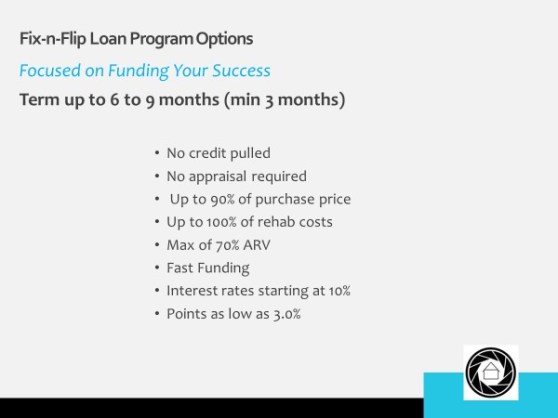
REI Capital Resources has funds available for fix-n-flip loans with terms up to 6 to 9 months with a minimum of 3 months.

Fix-n-Flip Option 2

E-mail or call for more information on minimum and maximum loan amounts, interest rates, terms, and fees for specific project. I can help you with first liens only and these loans are limited to the Austin, DFW, Houston, and San Antonio Metro areas.

Pat St.Cin

Patrick@reicapital.cash

512-213-2271

Austin, Texas

A Tangible Asset

A tangible asset is one that is capable of being appraised at a particular value. It can be touched. It can be identified. It is real. There is no guesswork about it. Hard money loans are based on the value of the asset or property used for collateral.

The stock market is impossible to control. If you read Investopedia or the Wall Street Journal, you know already that It will soar and dive and stall. However, it is just one option for an investment. Real estate is another choice you can make. Real estate would put some diversity into your investment portfolio. However, it takes a little more hands-on work and patience. In the stock market, all you do is decide how much you want to invest and put your money down and sell when you are ready.

In real estate, you have more choices to make. You decide how much time you want to invest as well as how much money. You should of course do the research upfront yourself and find a great real estate agent to work with, but you can choose the location of the property, pick the quality of the house or apartment complex, do the remodel yourself if you have the skills, find the occupants for a rental through internet advertising, and/or manage the rental yourself by collecting rents and providing landlord services.

A rental produces cash flow even in an economic downturn. In fact, in economic downturns, it might give you more income as people may have to rent instead of buy and occupancy rises. A rental property also builds equity. On the other hand, real estate takes longer to sell than stock and income requires occupants. There are also taxes, insurance, and utilities to pay whether the property is occupied or not.

If you are looking at buying real estate as an investment option, to add diversity to your basket of investment eggs, you need to do your due diligence assessments and be ready for competition. It would be a good idea to get prequalified for a loan so you can have the money on hand fast if you find a property you want to invest in.


img_00003745

Ask yourself:

How much money do I need?

How much collateral can I offer a lender?

How much will the repairs cost?

How long will the repairs take?

Add a 15 % cushion

As a broker, I would be happy to talk over the options with you and can help you find a funding source for a fee. I give advice, do the paperwork, and make the phones calls involved in the transaction. I have contacts and experience in bringing lenders and borrowers together. I’ll help you find the best rates and pass the completed loan package on the lender.

I would love to give you a hand.

Follow this link for a quick prequalification form:

http://investorslendingsource.com/pre-qualification-program

Or, please call or e-mail.

Pat St. Cin

Patrick@InvestorsLendingSource.com

512-213-2271

Austin, Texas

Efficiency 0.00, Romance 9,999.00

So much of what we do seems to be about the numbers, and that is the careful approach to money and real estate investing. Research, data, and knowing are key. Once we have enough numbers, coordinates, impressions, population flows, and price points, we can let the algorithms take over and decide for us if it is safe to jump, to invest. But where is the mystery in that? Where is the romance? In the book The Business Romantic, by Tim Leberecht, we read the staggering statistic that in the time it takes us to read one chapter in his book, “the human race will produce the same amount of data that currently exists in the U.S. Library of Congress. Big Data indeed.” Awk!

Too Much Measuring

Lebrerecht points out that in business, the mantra often is “You can’t manage what you can’t measure.” I’ve seen this in business. Managers trying to track performance data on every employee and somehow relate it to success. In our personal lives, the fashionable apps available to us also quantify our every heartbeat and the fate of every calorie, spitting out information about everything we eat and how it relates to our best-every performance. As we age, the mobile heart EKGs and breathing machines tell us if we are okay despite how we feel, or if it is time to call 911. Human agency it seems is being pressed out by the numbers.

And so it is in many of our decisions in this business we are in of borrowing, lending, buying, renting, and selling. Over and over I say, do the numbers, do your research, know what you are getting into. We want to know the numbers. We want to quantify all the potential risks and rewards. And, that is the sensible thing to do.

The Adventure

But there is another way to do business, the romantic way as Lebrercht points out in his book. It is the unpredictable way, the way of the gut. It is looking at business as the greatest adventure of the human experience. It is giving all we have and not counting the return. It is the leap of faith, our celebration of the unknown and the unexplainable. (I can just feel the office quake as all those business productivity managers falling out of their rolling desk chairs.)

So, I ask, what if we fall in love with a house? What if we want to embrace a neighborhood, a town. What if we are passionate about fixing this little house up so it is beautiful, each door knob polished to perfection, each mop board stained precisely? If that is the way we are feeling about our business, we are business romantics. It is taking the small and making it big.

In Love

When we are in love with our work, we do it for the sake of doing it. We see our work as bigger than ourselves as something with purpose. We don’t even notice our paychecks. We might not get along with everyone or be completely streamlined, but we are successful. We are improving neighborhoods, building communities, turning the sow’s ear into the silk purse.

My advice on this winter Friday in January is to forget the efficiency and give old romance a try. Seek out the mystery, the romance in property. Where a person lives is so important to them. It is our job to bring property to life, to engage in the business of buying and selling to create places where humans thrive and to thrive ourselves as we bring a dream to life.

That is it! Look at your work for what it is—creating places for humans to live! This is a high calling indeed.

jacqueminot_roses-martin_johnson_heade


I would love to give you a hand in whatever you endeavor to do.

Follow this link for a quick application form: http://investorslendingsource.com/pre-qualification-program


Or, please call or e-mail.


Pat St. Cin

Patrick@InvestorsLendingSource.com

512-213-2271

Austin, Texas


References

Jacqueminot Roses, painting by Martin Johnson Heade [Public domain] via Wikimedia commons.

Leberecht, T. 2015. The Business Romantic. New York, NY: HarperCollins.